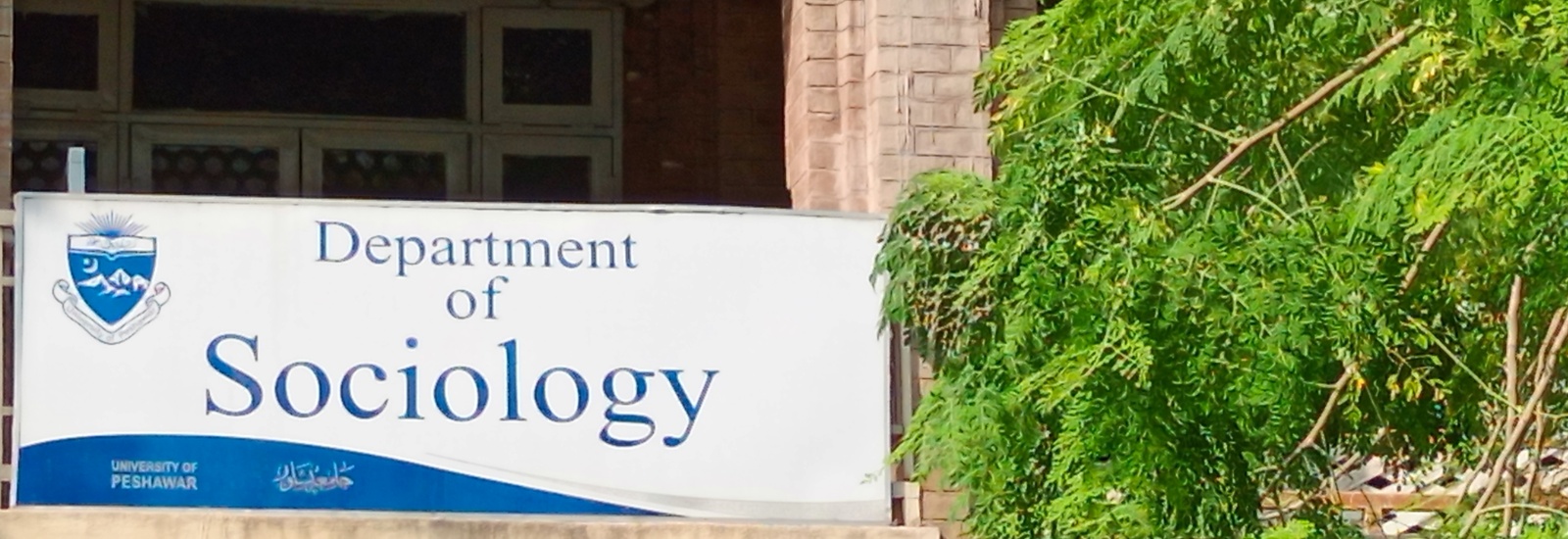
Department of Sociology
Department of Sociology
INTRODUCTION
The Department of Sociology was established in 1982. Its founder, the late Prof. Karam Elahi, who retired in 1994 as a Professor of Sociology & Anthropology, bequeathed to it a tapestry of academic achievements: he studied History in 1958 (University of Peshawar), Anthropology in 1967 (University of Edinburgh, Scotland), and a research fellowship at Columbia University (US) in 1972-73. Sociology at the University of Peshawar has followed in the footsteps of its founder, growing into a vibrant academic unit offering teaching, research, and consulting services across diverse disciplinary areas and issues, characterised by interdisciplinarity and multidisciplinarity.
Its eleven faculty members, some of whom have doctoral and postdoctoral research and teaching experience from abroad, specialise in a range of issues, some of which are: climate change and sustainability; evidence-based social and public policy; social change and development; sociology of markets and politics; civic and community engagement and development; gender, society, and social inclusion; qualitative and quantitative research; sociology of health and wellbeing; human rights, law and social justice; sociology of social problems; sociology of NGOs/TSOs/NPOs; institutional and organizational analysis; population studies and demography; indigenous communities; coloniality and decoloniality.
Currently, the department is running academic programs in Bachelor Studies (BS), Master of Philosophy (MPhil), and Doctor of Philosophy (PhD). Additionally, faculty members regularly engage in academic projects and commissioned research. UNDP, Plan International, Higher Education Commission (HEC), Pakistan Baitulmal, National Aids Control Programme (NACP), Plan International, ActionAid International, Pakistan Institute of Development Economics (PIDE), National Institute of Health Research (NIHR-UK), and Medical Research Council (MRC-UK) are some of the governmental and non-governmental national and international agencies for which we have served in undertaking academic and applied research as well as designing development interventions.
Quick Facts
0
Current Students
0
Our Graduates
0
Faculty Members